The standard advice is two hours before a domestic flight and three hours before an international one. That advice is fine as a starting point, but it hides the part that actually matters: your arrival time depends on your airport, your bags and the time of day, not on a single national rule.
A better approach is to work backwards from the boarding gate. Boarding usually closes 15 to 20 minutes before departure, and the gate itself can be a long walk from security. Everything before that point is a series of queues, and queues are the only thing you cannot compress.
Start with a baseline
- Domestic flight, carry-on only, small or medium airport: 90 minutes.
- Domestic flight with checked bags: 2 hours.
- International flight: 3 hours, because check-in and document checks take longer.
- Any flight from a very large hub in peak season: add 30 to 45 minutes.
These are targets for being inside the terminal, not for leaving your house. Add parking, the shuttle from the car park, or the time it takes to find the right terminal entrance. At some airports the walk from the train station to the check-in hall is ten minutes on its own.
Then adjust for your own situation
Add time if you are travelling with small children, if someone in the group needs assistance, if you are carrying sports equipment or a musical instrument, or if you have not flown from this airport before. Add time if you need to claim a tax refund on shopping, because those desks can have their own queue.
You can take time off if you have only a cabin bag, you have checked in online, you know the terminal, and you are flying at a quiet hour. Early afternoon on a weekday is often the calmest window of the day at many airports.
What actually eats the time
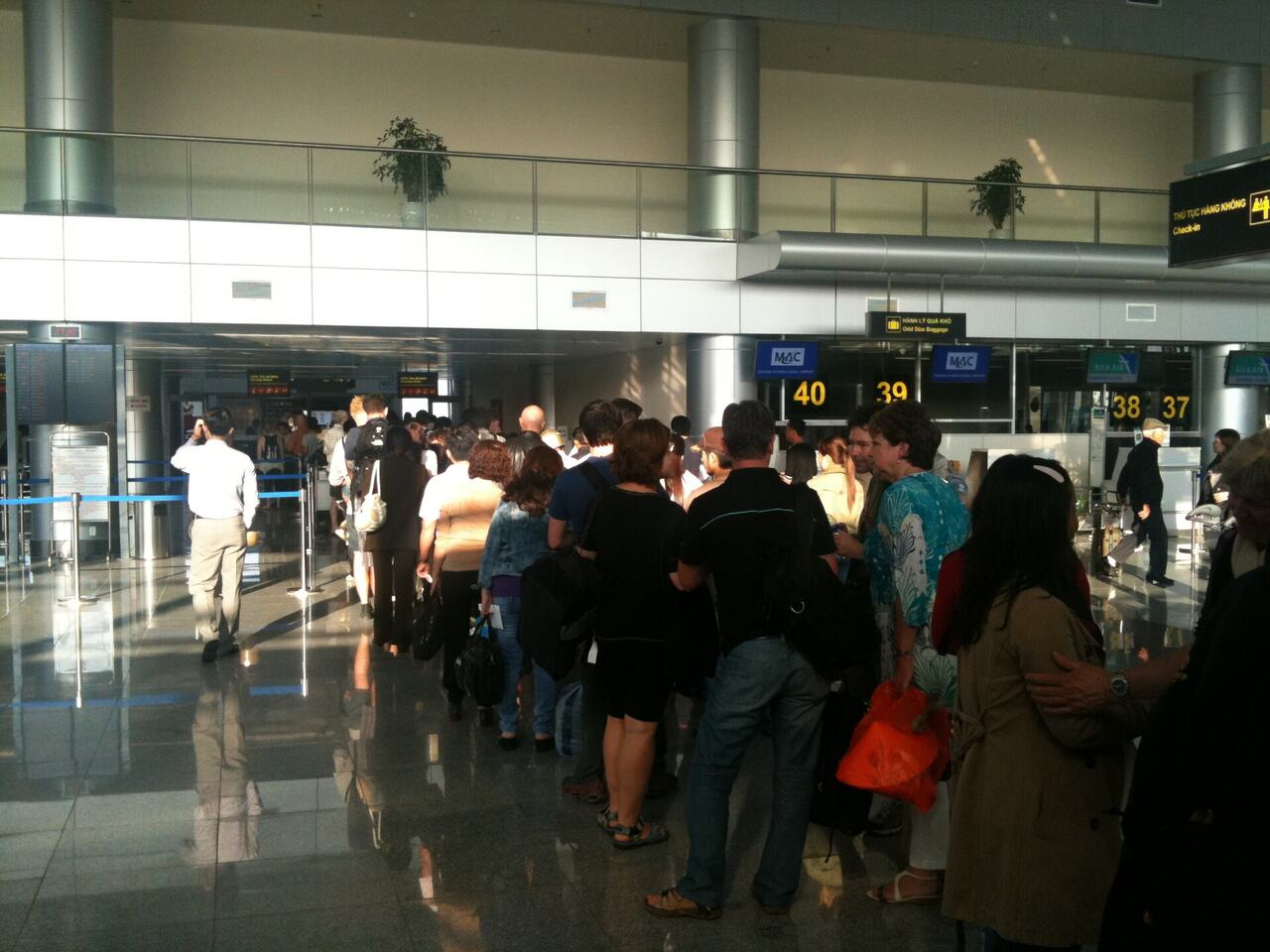
Security is the least predictable stage. On a quiet morning it can take four minutes. During a school holiday rush at a busy hub it can take fifty. Many airports publish live wait times in their app or on the website, and those numbers are usually honest enough to plan with.
Passport control on departure is the second variable. In countries with exit checks, that queue can be as long as security. If you are flying from a country that stamps you out, treat it as a separate stage in your plan.
The third factor is distance. Large airports are effectively small towns. A gate in a satellite concourse can be a 20 minute walk plus a shuttle train from the security exit. If your boarding pass shows a gate number, look at the terminal map before you sit down for coffee.
A simple planning method
- 1Note the departure time and subtract 20 minutes to find the likely gate closing time.
- 2Subtract 25 minutes for the walk to the gate at a large airport, or 10 at a small one.
- 3Subtract your realistic security estimate, using the airport's published wait time where available.
- 4Subtract 30 minutes if you need bag drop, or 45 if the airline has long counter queues.
- 5Add a 30 minute buffer that you are willing to spend sitting down with a coffee.
The buffer is the important part. Arriving with spare time costs you a wait in a seat. Arriving without it costs you the fare, the hotel night at the other end and quite often the connection too.
Trusted traveller and fast track programmes
Programmes that speed up screening or immigration are worth it if you fly more than a few times a year from the same airports. They shorten one stage of the process, not all of it, so keep the rest of your plan intact. Fast track lanes also close at quiet hours in some terminals, which surprises people who counted on them.
If you are running late
Go straight to the airline counter rather than the self service kiosk. Staff can sometimes escort late passengers or give you a security fast track slip if the flight is still open. Tell them your flight number immediately, and be honest about how late you are. If the bag drop is closed, ask whether you can travel with the bag as cabin baggage instead.
If you miss the flight, ask about the airline's late arrival policy at once. Some carriers offer a reduced fee standby seat on the next departure, others treat the ticket as forfeited. Either way you will get a better answer at the desk than over the phone.
Common questions
- Is two hours enough for an international flight?
- Often yes if you have no checked bags and know the airport, but three hours is the safer default. Long haul flights have earlier document check deadlines and heavier check-in queues.
- Does online check-in let me arrive later?
- It removes the check-in queue but not bag drop, security or passport control. Save around 20 to 30 minutes, not an hour.
- What if the airline app says the flight is delayed?
- Arrive at the original time anyway unless the airline has confirmed a new departure. Delays get shortened as often as they get extended.
Still stuck on something?
We publish information only, so your airline is always the right first call for a specific booking. If you cannot find an answer on the site, send us the question and we will point you to the right guide.